The vintage question.
You’ve heard the legend: old iron is better, Grandma’s pan cooks better than anything made today. Half of that is true. Old pans — the vintage Wagner and Griswold pieces everyone chases at flea markets — were milled smooth after casting, which is why an egg slides around a ninety-year-old skillet. The other half is selection bias: the bad old pans cracked or warped and got thrown away, and nobody kept receipts on those. What new iron gives you is consistent casting, a warranty, and a pan you can actually buy twice. Neither era has a monopoly on good cooking.
What actually matters.
Start with weight. Pick the pan up with one hand — now imagine it loaded with three pounds of food while you’re pouring. If you can’t manage that comfortably, it’s the wrong pan, no matter how it looks. The cooking surface comes next: a pebbly factory texture like Lodge’s cooks just fine once seasoning builds up; a milled-smooth surface like Field’s gets you there faster. Handle comfort matters more than anyone admits — hold it the way you’ll cook with it, not the way you’d photograph it. Pour spouts keep grease rivers off your stovetop. And on anything 12 inches or up, a helper handle opposite the main one isn’t a luxury; it’s how you carry the thing with two hands instead of one bad decision.
The seasoning truth.
Factory pre-seasoning is a starting point, not a finish line. Lodge pre-seasons its pans with vegetable oil so they arrive rust-free and ready to cook — but the slick black surface everyone wants comes from your cooking: fried chicken, cornbread, bacon, repeat. Nobody sells a finished seasoning, because a finished seasoning is just a record of what you’ve cooked. The pan that earns it is the pan you reach for most.
The size guide.
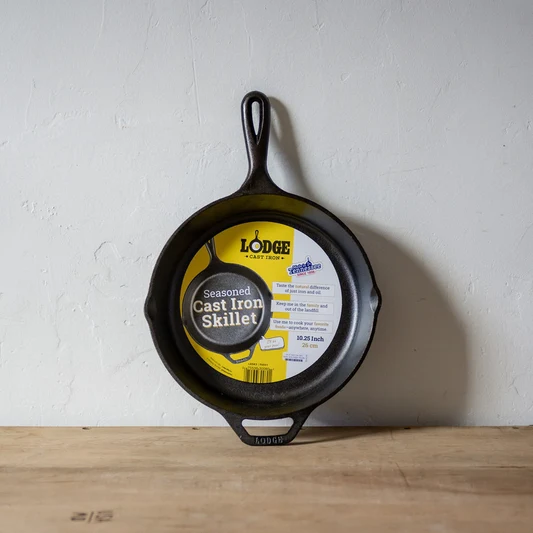
10.25 inches is the everyday pan — the one that lives on the stove. 12 inches feeds a family; the Lodge 12 is the standard here and the workhorse in most American kitchens that have one. 15 inches is camp and deep-batch territory — the Lodge 15, big chili, big fires, both hands. For eggs and solo cooking, reach for a No. 6 or No. 8; the Field Company No. 6 is built for exactly that job, lighter and smoother than the old guard by design.
Buy the pan you’ll actually cook in, not the one that photographs best. A skillet with a decade of your dinners in it beats the perfect pan sitting in the cabinet every time — and iron from South Pittsburg, Tennessee has the track record to get there.
More from Statemade:
The deer camp kitchen. →
← Back to Hunting
The Makers. →